
Protecting Higher Education in the Age of AI
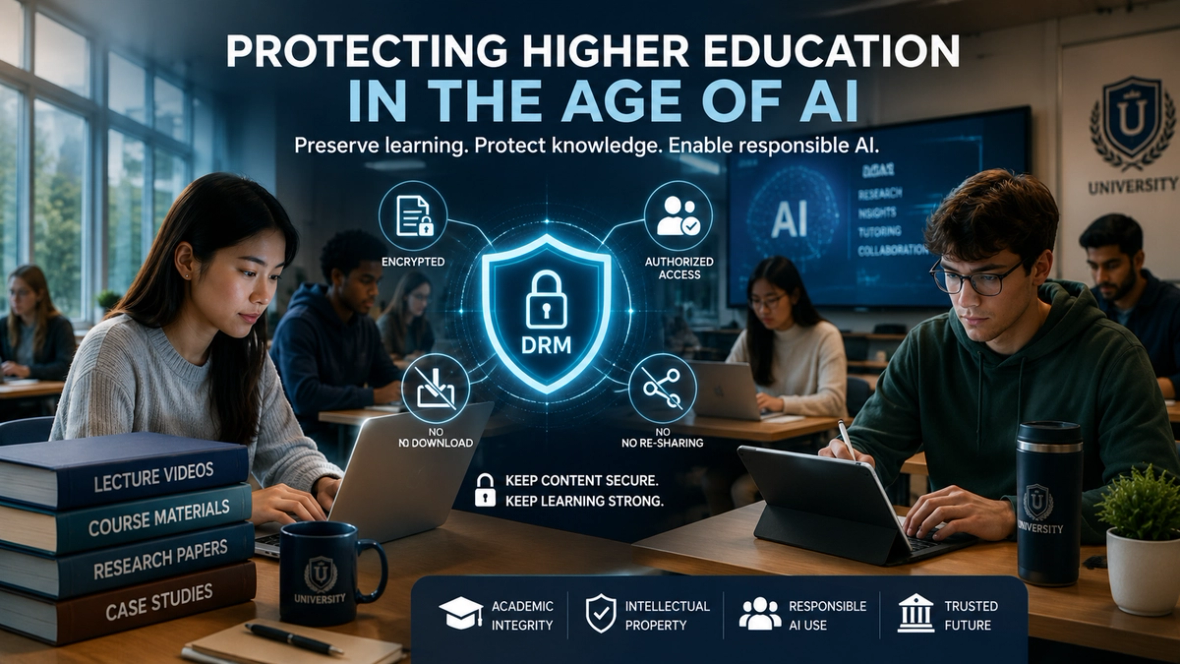
How universities can preserve academic integrity, safeguard intellectual property, and enable responsible AI use
AI presents higher education with a profound paradox. It can accelerate research, help students organize complex information, support personalized learning, and expand access to expertise. Yet the same technology can bypass the intellectual work that education is designed to develop—and can move valuable institutional content beyond the control of the university that created it.
Through conversations with educators at universities and colleges in the United States and Asia, I have found broad agreement on one point: AI can be an extraordinary tool when it supports human inquiry, but it becomes destructive when it replaces the mental intellectual process of that inquiry. Furthermore, there is mounting concern over the unauthorized use of proprietary educational content in the training of public AI models. This leads to the question; how educational institutionsrealize the benefits of AI without surrendering either the learning process or control of their intellectual property.
“The challenge is not to keep AI out of education, but to keep human learning and institutional knowledge at the center of it.”
Two AI risks higher education must address
The debate about AI in higher education often treats every concern as part of a single problem. In practice, institutions face two different risks, and each requires a different response.
1. When AI becomes a substitute for learning
Students can now download lecture recordings, course packs, readings, and problem sets, upload them to a public AI service, and ask the system to summarize the material or produce an assignment. Not every use of AI in this process is misconduct. A well-designed AI tutor can explain difficult concepts, suggest additional questions, or provide feedback on a student’s reasoning. The problem arises when AI performs the essential cognitive work that the student is supposed to develop.
If a student submits polished AI-generated work without understanding the underlying material, the model has been trained more than the student. Over time, this kind of cognitive outsourcing can weaken critical thinking, independent judgment, persistence, and the ability to formulate original arguments—the very capabilities that higher education exists to cultivate.
Universities therefore need to distinguish between AI-assisted learning and AI-substituted learning. That distinction must be reflected in assessment design, transparent rules, faculty practice, and the technical controls applied to course content.
2. When institutional knowledge leaves institutional control
Lecture recordings, course materials, faculty papers, case studies, and research data are not simply files. They represent years of faculty expertise and institutional investment. They may also contain unpublished research, licensed third-party content, confidential information, or material that should be available only to enrolled students.
When authorized users download this content and upload it through personal accounts to public AI services, the university may lose visibility into how the material is processed, retained, or reused. Enterprise agreements and nondisclosure provisions with approved AI vendors can reduce risk, but they do not necessarily govern what students, faculty, or staff do with public services outside institutional systems. The broader legal disputes between AI developers and authors, publishers, and other rights holders demonstrate that the use of protected content for AI development remains a significant and contested issue.
This is not only a copyright question. It is also a governance question: can an educational institution continue to share knowledge broadly with its community while maintaining meaningful control over where that knowledge goes?
Why policy alone is not enough
Acceptable-use policies, academic honor codes, faculty guidance, and student education are essential. However, policy without enforcement depends almost entirely on individual compliance. A rule that says “do not upload course materials to public AI” does not prevent a file from being downloaded, copied, or forwarded. Nor does it allow the institution to stop access after the content has left the learning management system.
Universities need a layered approach in which policy defines permitted behavior, assessment design rewards genuine learning, approved AI environments provide safe alternatives, and technical controls reduce the opportunity for unauthorized use. One of the most practical controls available at the content layer is digital rights management, or DRM.
DRM for educational content as a control layer
DRM applies persistent protection to a document or video rather than relying solely on the security of the platform where it is stored. Content can be encrypted and made accessible only to authenticated users, such as instructors and registered students. Depending on institutional policy and configuration, controls can restrict downloading, copying, printing, screen capture, and resharing; add visible or forensic watermarks; record access activity; and stop access when authorization changes.
When DRM is integrated into a learning management system, students can continue to access the materials they need while the institution retains greater control over the original files. Public AI services and automated agents are not authenticated members of the course, so they cannot directly open protected source content. This substantially reduces the ease with which a complete lecture video, course pack, or research document can be transferred into an external AI system.
No technical control can eliminate every form of misuse. A determined user may still retype information, photograph a screen, or paraphrase content. The value of DRM is that it changes the default condition from unrestricted distribution to controlled access. It raises the effort required to remove content from its authorized context, creates accountability, and gives the institution an enforcement mechanism that policy alone cannot provide.
At 689Cloud, we have provided DRM for education to universities and educational institutions to protect lecture videos, course materials, papers, and other documents from unauthorized use and disclosure. This work has revealed an important new use case for content security: protecting educational materials from unauthorized AI ingestion while also discouraging students from outsourcing the learning process itself.
Responsible AI still has an important role
Protecting course content should not be confused with rejecting AI. Universities should actively create approved ways for students and faculty to use AI for research support, brainstorming, data analysis, language assistance, formative feedback, and the exploration of difficult concepts. The objective is to ensure that AI extends human capability rather than replacing the intellectual effort that produces understanding.
A student who has engaged with a lecture, taken notes, formed a preliminary interpretation, and then uses AI to test an argument is using the technology very differently from a student who uploads the lecture and asks for a finished assignment. The first approach can deepen learning. The second bypasses it. Institutions need policies and systems that make this distinction visible and enforceable.
A practical AI governance framework for higher education
A sustainable institutional response should combine technology, pedagogy, and governance. Six principles provide a useful starting point:
1. Classify educational content. Identify which materials are public, course-restricted, confidential, licensed, or research-sensitive. Protection should be proportionate to the value and risk of the content.
2. Protect content at the point of distribution. Apply access controls and DRM through the LMS or content platform so that protection remains with the file after it is delivered to an authorized user.
3. Define acceptable AI use by activity. Rules should distinguish research assistance, tutoring, editing, and idea generation from unauthorized authorship, assessment completion, or the uploading of protected materials.
4. Redesign assessment for the AI era. More emphasis should be placed on oral defense, iterative work, in-class reasoning, project logs, reflection, and other evidence of the student’s own intellectual process.
5. Provide approved AI environments. Students and faculty are more likely to follow institutional rules when secure, useful alternatives are available for legitimate academic work.
6. Monitor and adapt. AI capabilities, vendor policies, and student behavior will continue to change. Governance should be reviewed regularly rather than treated as a one-time compliance exercise.
Keeping learning—and knowledge—under human control
The future of higher education will not be secured by trying to exclude AI from the classroom. It will depend on whether institutions can establish boundaries that preserve the conditions under which genuine learning and original scholarship occur. When AI supports inquiry, it can strengthen education. When it replaces thinking or absorbs protected knowledge without meaningful control, it can weaken the foundations of the institution.
DRM is not a complete answer to the challenges created by AI, but it can provide a critical enforcement layer. It helps universities share knowledge with the people who are entitled to use it, limit unauthorized redistribution, and maintain control after content has been delivered. Combined with clear policy, modern assessment, and secure AI services, it can support a more responsible model for AI-enabled education. The goal is simple: students should use AI after they begin thinking—not instead of thinking.
Protecting educational content in the AI age
Universities and learning providers can integrate 689Cloud DRM technology into learning management systems and existing content platforms to protect lecture videos, course materials, papers, and research documents. Contact 689Cloud to discuss your educational content-protection requirements.
Frequently Asked Questions
What are the main risks of AI in higher education?
Universities face two distinct risks. The first is academic: students may use AI to replace the intellectual work that assignments are intended to develop. The second is institutional: lecture recordings, course materials, research, and other proprietary content may be transferred to external AI services beyond the university’s control.
How can universities prevent students from uploading course materials to public AI services?
Universities need a layered strategy. Clear policies and student education should be combined with redesigned assessments, approved AI environments, access controls, and persistent content protection. DRM can make it substantially more difficult to download, copy, or transfer complete protected materials into an unauthorized AI service.
Can DRM prevent AI from reading protected educational content?
DRM can encrypt documents and videos and require an authenticated, authorized user before the content can be opened. Because a public AI service is not an authorized course participant, it cannot directly open the original protected file. DRM cannot prevent every possible form of misuse, such as retyping information or photographing a screen, but it changes the default condition from unrestricted distribution to controlled access.
Does protecting educational content mean that universities should ban AI?
No. Universities should provide approved ways for students and faculty to use AI for research assistance, tutoring, data analysis, brainstorming, language support, and formative feedback. The objective is to use AI to extend human capability without allowing it to replace the intellectual effort required for genuine learning.
What should an AI governance framework for higher education include?
A practical framework should classify educational content, protect sensitive material at the point of distribution, define acceptable AI use by activity, redesign assessments, provide secure and approved AI environments, and regularly review policies as technology and user behavior change.